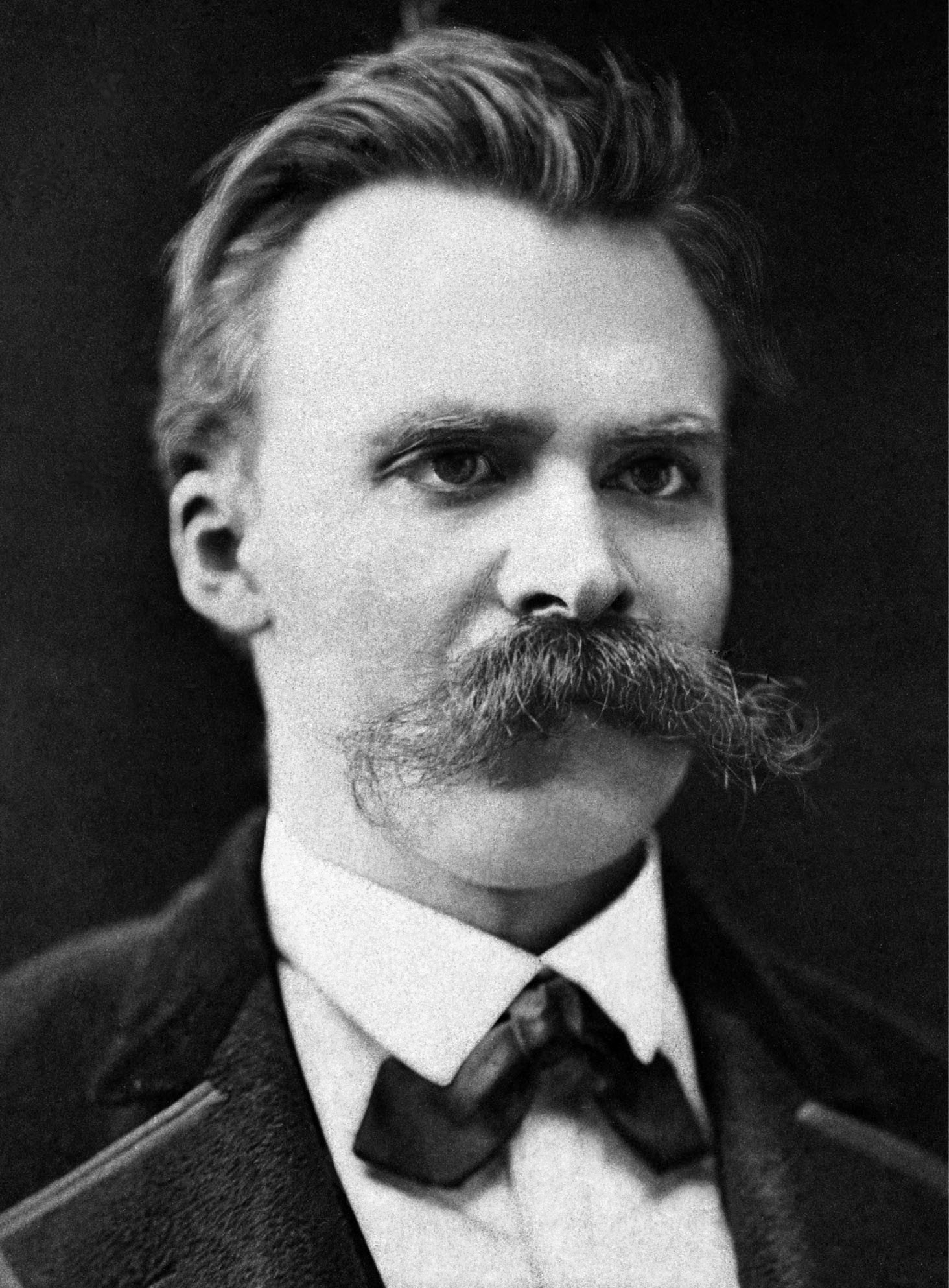
Friedrich
Nietzsche
Friedrich
Nietzsche was born on October 15, 1844, in Rocken, Germany, where his father
served as a Lutheran pastor. Friedrich’s father’s death, when he was four years
old, was distressing, which he often referred to in his later writings. Soon
after, his youngest brother died, resulting in his mother moving her family in
with her mother and two sisters. The death of both his father and his brother
left Nietzsche in a household of woman including his sister, Elizabeth.
After attending
local schools in Naumburg, in 1858 Nietzsche won a scholarship to Pforta, one
of the best boarding schools in Germany. Here he received a thorough training
in the classics and acquired several life-time friends. At the end of this
period of schooling, Nietzsche, who had earlier shared the Lutheran religion of
his family, found that he had ceased to accept Christianity-a view that soon
hardened into outright disbelief in any God. With the highest recommendations
of his Pforta teachers, Nietzsche enrolled in the University of Bonn in 1864.
On
January 3, 1889, Nietzsche collapsed on a street in Turin, Italy. When he
regained consciousness, his sanity was gone. He began to send off wild letters
to friends and strangers signed “Dionysus-the Crucified.” He was taken to his
mother’s home and lived on in a semiconscious state, sinking ever further from
the real world until his death on August 25, 1900.
Nietzsche
believed that European man was standing at a critical turning point. The
advance of scientific enlightenment, in particular the Darwinian Theory
(Darwin’s theory that man evolved from primitive life forms), had destroyed the
old religious ideas. In thus Spoke Zarathustra, Nietzsche wrote: “God is dead.
“Further, he declared that man no longer “the image of god,” is a chance
product of a nature uninterested in purpose or value. The great danger is that
man will find his existence meaningless. Unless a new grounding for values is
provided, Nietzsche predicted a rapid weakening into destruction for society.
Nietzsche aimed
in all his work to provide a new meaning for human existence in a meaningless
world. In the absence of any religious guidance, men must create their own
values. Nietzsche’s writing is either criticisms of the old system of values or
attempts to form a new system. For European man, the traditions common to both
Jewish and Christian religions were the source of the old values. Nietzsche
attacked it head-on in such works as A Genealogy of Morals (1887) and The
Antichrist (1888).
In Nietzsche’s
constructive works he sought to find in life itself a force that would serve to
set human existence apart. He found it in the theory of the urge to dominate
and master. All creatures desire this, but only man has achieved sufficient
power to turn the force back on himself. Self-mastery and self-overcoming are
the qualities that give a unique value to human life. The ideal man, the “superman,”
will delight in being the master of his life, measuring out his passion, and
giving style to his character. His power over himself and his life will give
him a flood of a creative energy. This will be the new reality and the standard
by which all of life is judged.
All
morality (right conduct) is therefore the result of overcoming one’s self, but
Nietzsche had a standard by which to tell between the morality of the superman
from the morality of Christianity. Christianity is based on the concept of
afterlife. It attacks the idea of being master of your life, calling that idea
“pride,” and sees natural passions as evil, putting guilt and fear into its
followers. The new morality, on the other hand, will support life, encourage
self-assertion, and do away with guilt. In Thus Spake Zarathustra (1883)
Nietzsche formed the ultimate test of the superman’s statements. Confronted
with the notion that the world process is cyclical (circular or in sequence)
and eternal, the superman still supports life.


GOOD WORK!
TumugonBurahinwow ang galing
TumugonBurahinNice nice nice
TumugonBurahinNice nice nice
TumugonBurahinNice pre
TumugonBurahinWow
TumugonBurahinWow
TumugonBurahinWow
TumugonBurahingalinh
TumugonBurahingalinh
TumugonBurahinnice work :)
TumugonBurahinNicely done
TumugonBurahinPower!
TumugonBurahinNice One!
TumugonBurahinPede na😅
TumugonBurahinGaling
TumugonBurahinPower☝
TumugonBurahinnice! :D
TumugonBurahinvery well redefined work
TumugonBurahinHahahahahahahaha!
TumugonBurahinNicely Done��
BurahinI really like what you are doing, keep up the good work
BurahinGood work
TumugonBurahinThank you
TumugonBurahinWork for something because it is good.
TumugonBurahinnice work!
TumugonBurahinorayt!
TumugonBurahinnice comment back
TumugonBurahinNice nice
TumugonBurahinImao hahaha
TumugonBurahinvery informative nice one!
TumugonBurahinA non-believer huehue. Nice Story! Thumbs up. ��
TumugonBurahinnice
TumugonBurahinThank you! ☝
TumugonBurahinAng pogi ko :)
TumugonBurahinTugon
TumugonBurahin